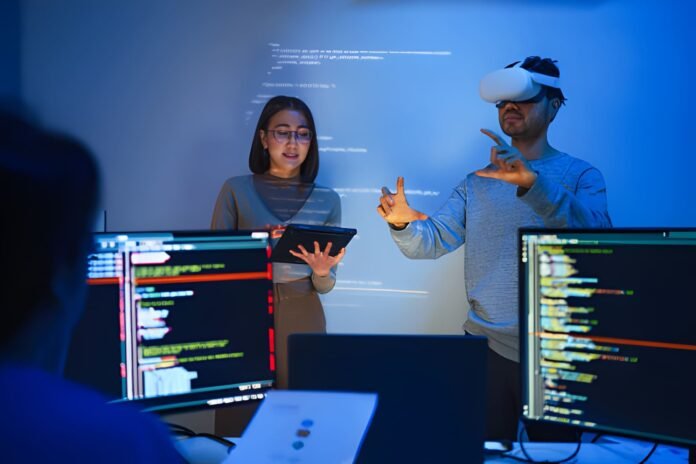
A New Chapter in Human-Technology Interaction
For decades, the way humans interacted with digital systems followed a predictable path keyboards, mice, touchscreens, and voice commands. But a new era is emerging, driven by rapid advancements in mixed reality, advanced sensors, and AI-enabled spatial mapping.
This evolution is called spatial computing, and it promises to fundamentally change how people work, shop, design, and communicate. From immersive workplaces to virtual product testing, spatial computing is quickly becoming the next platform shift after mobile.
What Exactly Is Spatial Computing?
Spatial computing blends augmented reality (AR), virtual reality (VR), AI, and real-world environment mapping to create digital experiences that feel physically present.
It enables devices to:
- Understand physical space
- Recognize objects and people
- Overlay digital information onto the real world
- Create immersive, 3D environments for work or play
Unlike traditional screens, spatial computing turns the user’s surroundings into an interface making technology more intuitive, contextual, and interactive.
The Industries Being Transformed
Spatial computing is no longer limited to gaming. Today, it’s impacting:
- Healthcare: Virtual surgery simulations, AR-guided procedures, and remote diagnostics are moving into mainstream medical practice.
- Real Estate: Developers are offering immersive property tours, letting buyers explore spaces without visiting physically.
- Manufacturing: Technicians can receive real-time instructions overlaid on machinery, reducing errors and training time.
- Education: Virtual labs, historical recreations, and immersive classrooms are enhancing student engagement.
- Aviation & Defense: Pilots and defense personnel use spatial simulators for high-risk training scenarios.
Retailers are exploring virtual product trials, letting customers visualize furniture, clothing, or home goods before purchase reducing return rates and increasing customer satisfaction.
The Challenges Still Ahead
Despite its potential, spatial computing faces real obstacles:
- High device costs
- Limited mainstream adoption
- Privacy concerns around persistent environment scanning
- Motion sickness issues for some users
- Lack of universal standards across platforms
Analysts predict that overcoming these challenges will require improved sensors, lighter hardware, and more powerful AI models.
The Road Ahead
Spatial computing is not just another tech trend it represents a long-term shift in how humans perceive and interact with digital information.
As devices become lighter, cheaper, and more intuitive, experts believe spatial computing could eventually replace traditional screens, just as smartphones replaced landlines and desktop-only computing.
The companies embracing this shift early stand to redefine the next decade of digital life.


Leave a Reply